
What Is RevOps? Revenue Operations for B2B Fintech
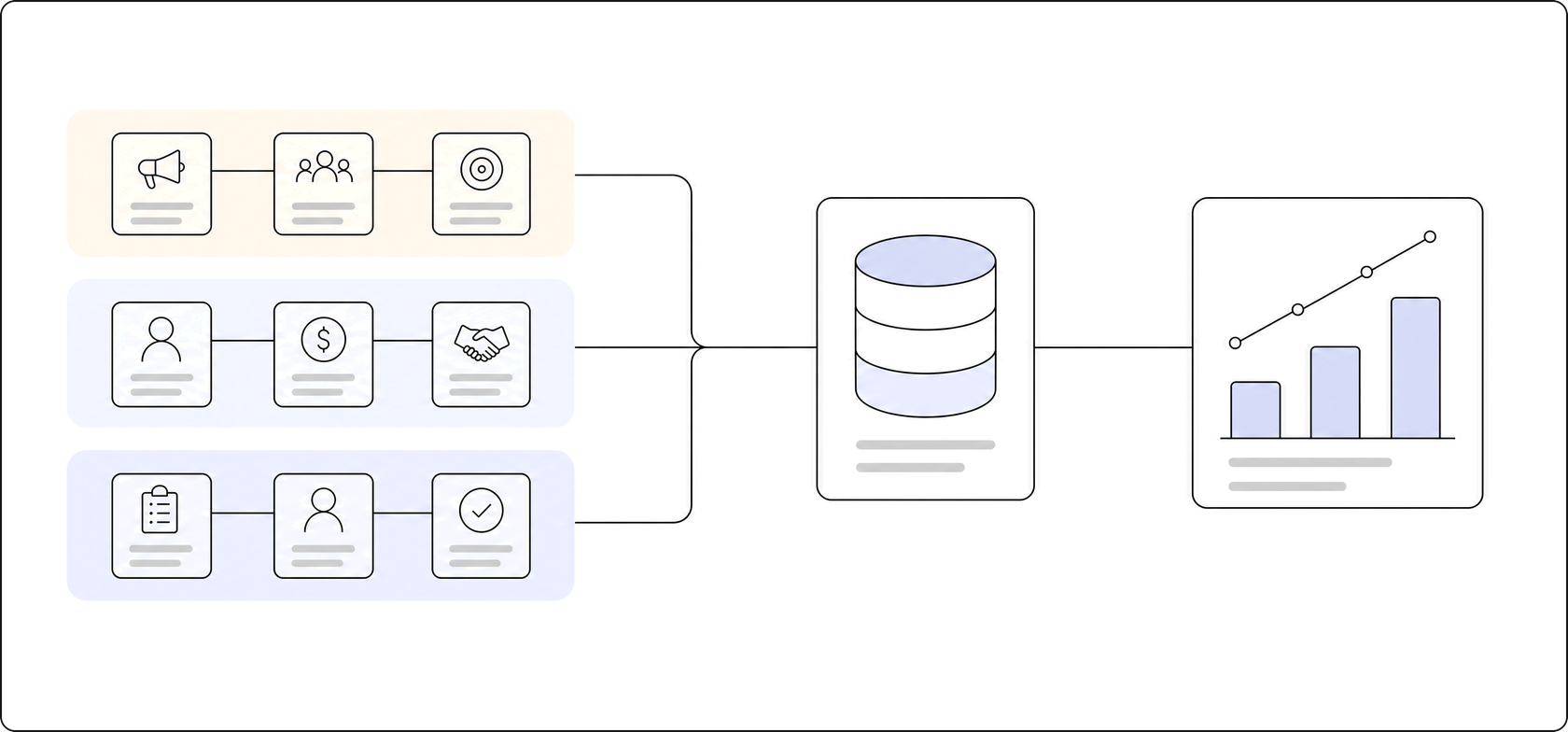
RevOps (revenue operations) is the function that runs sales, marketing and customer teams on one set of data, processes and tools, so a company can see where revenue comes from and grow it predictably. It owns the CRM, the funnel definitions, the handoffs between teams and the reporting.
In B2B fintech, RevOps has one extra job. Revenue rarely starts when a contract is signed; it starts when the customer is onboarded, goes live and processes volume. A RevOps setup that stops at closed-won misses the part of the funnel where fintech revenue is actually made.
What RevOps covers
| Area | What it includes | What it produces |
|---|---|---|
| Data and CRM | Accounts, contacts, deals, partners and the fields that describe them | One CRM the whole company trusts |
| Funnel and process | Stage definitions, lead routing, handoffs between teams | Clear rules for what happens to every lead and deal |
| Tools | The CRM, data providers, automation and how they connect | A stack with an owner, without overlaps |
| Reporting | Pipeline, conversion, forecasts and channel performance | Numbers the team reviews every week |
RevOps compared with sales ops and marketing ops
Sales operations and marketing operations each optimise their own team. RevOps looks at the whole path from first touch to revenue.
| Marketing ops | Sales ops | RevOps | |
|---|---|---|---|
| Focus | Campaigns, lead capture, scoring | Pipeline, territories, forecasting | The whole revenue funnel |
| Owns | Marketing tools and lead data | CRM and sales process | Shared data, process and reporting |
| Measures | Leads and campaign results | Pipeline and bookings | Revenue, conversion at every step |
Most seed to Series B fintechs don’t need all three. One person, or one part-time role, usually covers RevOps for the whole company.
Why RevOps is different in B2B fintech
Revenue starts at go-live. For payments and infrastructure products, a signed contract is worth little until the customer is live and transacting. RevOps should track onboarding, time to go-live and volume ramp, not just deals won.
Onboarding is part of the funnel. Due diligence, KYB checks, contracts and integration all sit between signature and revenue. Each step has an owner and can stall. Treat them as funnel stages with their own conversion rates.
Partners source deals. Banks, payment providers and platforms often introduce customers. Without partner fields in the CRM, you can’t see which partnerships produce revenue.
Buying committees are large. Several people from the same account touch your marketing and sales. RevOps has to connect them to one account, or reporting overstates leads and understates engagement.
Signs a fintech needs RevOps
- Nobody trusts the CRM. Sales keeps its own spreadsheet, and pipeline reviews start with arguments about the numbers.
- Forecasts are guesses. You can’t say with confidence what will close this quarter.
- Leads fall through the cracks. Inbound requests wait days for a reply, or nobody knows who owns them.
- You can’t say which channel works. Marketing and sales report different numbers for the same quarter.
- Signed customers take months to go live, and nobody owns the delay.
What to set up first
1. Define the funnel stages
Write down every stage from first contact to transacting customer, and what moves an account from one to the next. A typical fintech funnel runs: target account, engaged, meeting, opportunity, contract signed, onboarding, live, transacting. Everyone uses the same definitions.
2. Clean the CRM
Fix the data model before adding tools. Accounts, contacts, opportunities and partners need clear relationships, and each field needs a reason to exist. Remove the fields nobody uses.
3. Set up routing and handoffs
Decide who owns every inbound lead and how fast they reply. Define the handoffs from marketing to sales and from sales to onboarding, with what each team needs to receive.
4. Build one weekly report
Start with one dashboard: pipeline created by channel, conversion between stages, deals won, and time from signature to go-live. Review it every week with sales and marketing together.
5. Give it one owner
RevOps without an owner decays within a quarter. Someone has to own the definitions, the data quality and the tools.
The metrics that matter
| Metric | Why it matters in fintech |
|---|---|
| Pipeline created, by channel | Shows which channels and partners actually produce opportunities |
| Conversion between stages | Shows where deals stall, including compliance and onboarding |
| Win rate and sales cycle | Sets realistic targets for the plan |
| Time from signature to go-live | Revenue doesn’t start until the customer is live |
| Volume ramp after go-live | Shows whether customers grow into the revenue you expected |
Who should own RevOps
At the earliest stage, a founder usually does it by default. The next step is a part-time owner: a fractional leader or a specialist who sets it up and documents it. A full-time RevOps hire makes sense once sales and marketing teams are large enough that keeping the system running is a job in itself.
RevOps overlaps with GTM engineering: RevOps defines the process and the data, GTM engineering automates the work that runs on it. The difference is covered in GTM engineering for B2B fintech.
Common mistakes
- Buying tools first. A new tool on top of a messy CRM gives you a faster mess.
- Stopping at closed-won. In fintech, the revenue is after the signature.
- Too many fields and stages. If the team won’t fill it in, the data is wrong.
- Reporting nobody reviews. A dashboard only helps if a team acts on it every week.
Where to go from here
RevOps works best when it serves a clear go-to-market strategy. Fuente Digital sets up the CRM, routing and reporting for B2B fintech and payments companies as part of GTM engineering, and runs it ongoing as a fractional head of growth.
Frequently asked questions
What does RevOps stand for?
RevOps stands for revenue operations: the function that aligns sales, marketing and customer teams around shared data, processes, tools and reporting.
What is the difference between RevOps and sales operations?
Sales operations supports the sales team: pipeline, territories and forecasting. RevOps covers the whole revenue funnel, from marketing through sales to onboarding and customer growth, with one set of data and definitions.
When should a startup hire its first RevOps person?
Usually once there is a sales team of several people and more than one channel producing pipeline. Before that, a founder or part-time specialist can set up the basics and document them.
What tools does RevOps need?
A CRM is the core. Most teams add a data or enrichment provider, a workflow automation tool and a reporting layer. Start with the CRM you have and add tools only when a process needs them.