
Go-to-Market Strategy for B2B Fintech: A Step-by-Step Framework
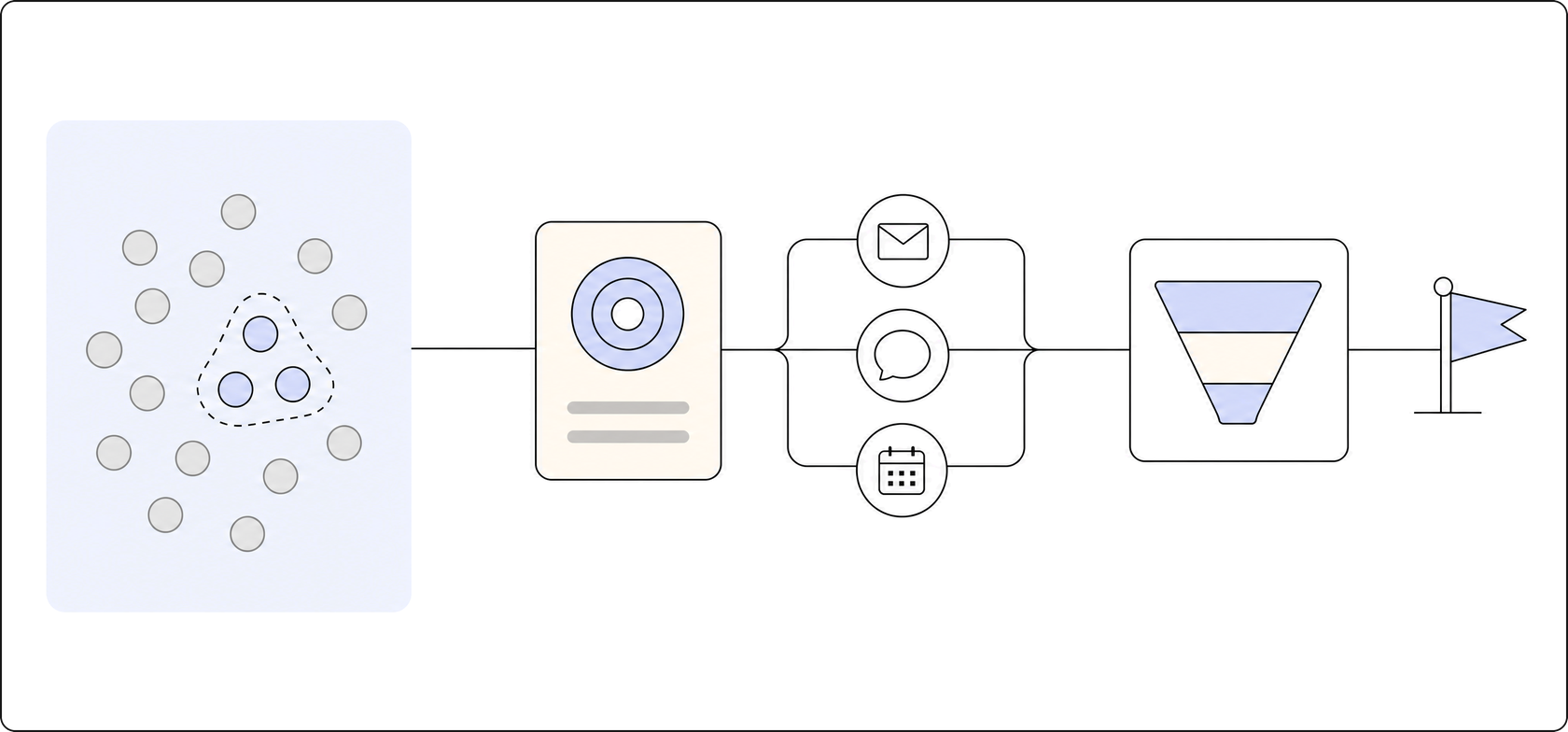
A go-to-market strategy is the plan for how a company wins its next customers: who it sells to, what it says, which channels and sales motion it uses, and the targets that show whether it’s working. It turns a product into pipeline.
For a B2B fintech, the strategy has to cope with a small, named market, long sales cycles with compliance and procurement involved, and buyers who need proof before they trust a new provider. This framework covers the seven decisions that make up a GTM strategy, in the order to make them.
What a go-to-market strategy includes
A GTM strategy is a set of connected decisions. Each one answers a question, and each produces something the team can use.
| Component | The question it answers | What it produces |
|---|---|---|
| Target segment | Which market do we win first? | One beachhead segment, with a reason |
| Ideal customer profile | Which companies and people buy? | An ICP and a map of the buying committee |
| Positioning and messaging | Why us, instead of what they use today? | A positioning statement and messaging per buyer |
| Sales motion | How do deals happen? | Sales-led, partner-led or product-led, or a mix |
| Channels | Where do buyers find us? | Two or three priority channels |
| Targets | How much pipeline do we need? | Monthly targets for leads, meetings and pipeline |
| Launch plan | What happens first? | A 90-day plan with an owner for every task |
A go-to-market plan is the last row: the schedule that puts the strategy into action. The strategy is the decisions above it.
Why go-to-market is different in B2B fintech
Generic GTM advice assumes a large market and a quick sale. Fintech rarely gets either.
Distribution often runs through partners. Banks, payment service providers, platforms and resellers can bring more customers than direct sales. Some fintechs can only reach their market through one of them.
Regulation sets the pace. Licences, due diligence and security reviews decide which markets you can sell into and how long a deal takes. The strategy has to plan around them, not ignore them.
Buyers need proof. A head of payments or a CFO is trusting you with money flows. Reference customers, security documentation and a clear explanation of how funds are held often matter more than features.
The market is finite. You can usually list every company that could buy. That changes the job from generating volume to winning the right accounts.
Step 1: Pick one beachhead segment
Most early fintechs try to sell to everyone their product could serve. A beachhead is the one segment you win first, then use as proof for the next.
Score each candidate segment on four things: how badly they feel the problem, whether you can reach them, how fast they buy, and whether winning them helps you win the next segment. The best beachhead is rarely the biggest market. It’s the one where you can become the obvious choice quickly.
Step 2: Define the ICP and the buying committee
An ideal customer profile describes the companies that get the most value from you: segment, size, region, licences, the payment methods or currencies they use, and the trigger that makes them look for a provider.
In fintech, the ICP also needs the people. Map who is involved in a deal (typically payments or product, finance, compliance, engineering and procurement), what each cares about and who can say no. Your messaging and sales process depend on this map.
Step 3: Position against the real alternative
Positioning decides why a buyer should choose you over what they do today. For most B2B fintechs, the real competitor is the bank relationship, a legacy provider or an internal team, not the startup on the next stand at a conference.
Write it down as a positioning statement, then turn it into messaging for each member of the buying committee. Every channel decision after this depends on it.
Step 4: Choose the sales motion
The sales motion is how deals actually happen. Most B2B fintechs use one of three, or a mix.
| Motion | How it works | Fits when |
|---|---|---|
| Sales-led | Your team finds, qualifies and closes deals | Deal sizes are large and buyers expect a conversation |
| Partner-led | Banks, PSPs or platforms bring or resell your product | Partners already own the relationship with your buyers |
| Product-led | Buyers sign up, test and start using it themselves | Developers or small teams can adopt it without a long review |
Pick a main motion and make the others support it. A sales-led company can still use partners for introductions; a product-led one still needs sales for its largest accounts.
Step 5: Choose two or three channels
Channels are where buyers first meet you (each is covered in more depth in B2B lead generation for fintech). The common ones in B2B fintech are outbound to a named account list, events, partnerships, content and search, and PR and founder visibility.
Choose two or three and run them properly, rather than six half-heartedly. The right ones follow from the earlier steps: a finite market with a sales-led motion points to account-based outbound and events; a developer audience points to content, documentation and community.
Increasingly, buyers also ask AI assistants like ChatGPT and Perplexity to compare providers. Whatever channels you choose, check how those assistants describe you.
Step 6: Set pipeline targets from the revenue goal
Targets turn the strategy into numbers the team can manage. Work backwards from the revenue goal, using your own conversion rates where you have them.
A simple, illustrative example: to win 10 new customers in a year with a 25% win rate, you need 40 qualified opportunities. If half of first meetings become opportunities, that’s 80 first meetings, or about seven a month. Replace these figures with your own; the point is to know which number each channel has to deliver.
Track leads, meetings and pipeline by channel every week, so you can see early which channels are working.
Step 7: Write a 90-day launch plan
The plan makes the strategy happen. A useful shape for the first three months:
- Days 1 to 30: finalise positioning and messaging, build and score the account list, set up tracking.
- Days 30 to 60: launch the priority channels and the first automations.
- Days 60 to 90: review results by channel, double down on what works and cut what doesn’t.
Give every task an owner and a date. A strategy without owners is a document.
A one-page go-to-market strategy template
Before you launch, you should be able to fill in each line in a sentence or two:
- Beachhead segment: who we win first, and why them
- ICP: the companies, the trigger, and the people in the buying committee
- Positioning: for whom, instead of what, and why we win
- Sales motion: sales-led, partner-led or product-led, and how deals close
- Channels: the two or three we will run, and what each must deliver
- Targets: monthly leads, meetings and pipeline, by channel
- Proof: the references, case studies and documents buyers will ask for
- 90-day plan: the first tasks, with owners and dates
If a line is hard to fill in, that’s the decision to make next.
Common mistakes
- Too many segments at once. A strategy for banks, fintechs and enterprises at the same time is a strategy for none of them.
- Channels before positioning. Outbound and ads only spread the message faster. If the message is wrong, they spread the wrong one.
- No targets. Without monthly numbers, it takes months to notice a channel isn’t working.
- Ignoring partners. In fintech, one good partner can be worth more than a year of cold outreach.
Where to go from here
A go-to-market strategy is only as good as the systems that run it. Once the decisions are made, account research, outbound, routing and reporting can be automated, as covered in GTM engineering for B2B fintech. Some teams then bring in a fractional leader to run it.
Fuente Digital builds go-to-market strategies for B2B fintech and payments companies, starting with a fixed-price positioning sprint.
Frequently asked questions
What is the difference between a GTM strategy and a marketing strategy?
A marketing strategy covers how you build awareness and demand. A go-to-market strategy is wider: it also decides the target segment, the sales motion, pricing and packaging, partners and the targets for the whole revenue team.
What is the difference between a go-to-market strategy and a go-to-market plan?
The strategy is the set of decisions: who, what, how and how much. The plan is the schedule that puts those decisions into action, usually for the next 90 days.
How long does it take to build a go-to-market strategy?
A focused team can make the core decisions in a few weeks, if it talks to customers and limits itself to one segment. It then takes a quarter of running the plan to see which channels work.
When should we revisit our go-to-market strategy?
When something changes the answers: a new segment or market, a new product, a new licence, a funding round, or a quarter where the targets are clearly missed. Otherwise, review it every six months.